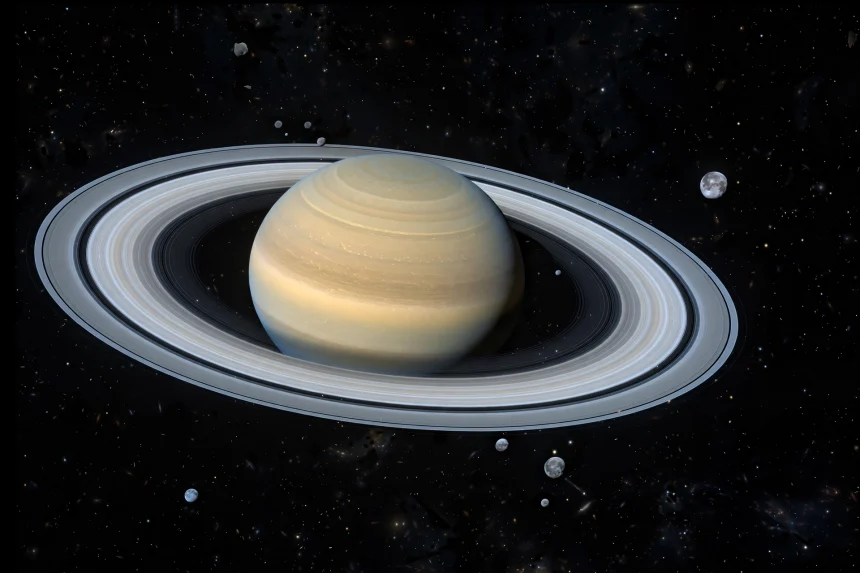
Some space stories begin with a countdown. Saturn’s latest began with an archive. Astronomers working through deep telescope images gathered over several years have confirmed 128 additional moons, taking Saturn’s total to 274, more than all the other planets combined. The announcement looks like a sudden jump in a chart. Behind it is a slower media story about data, verification and the point at which a faint candidate becomes a fact a newsroom can publish.
The images came first, the headline later
The observations were made with the Canada-France-Hawaii Telescope on Mauna Kea. Its field around Saturn contained objects far too dim to announce from a single frame, so the team used shift and stack: exposures were aligned for Saturn’s expected motion and combined until genuine companions emerged. The Canada-France-Hawaii Telescope provides background on the observatory, while recognition of the moons came from the International Astronomical Union after orbits had been established.
University of British Columbia researchers, including Dr Edward Ashton, were part of the effort. Their role illustrates a modern pattern in science communication: the publishable unit is rarely one observation. It is a chain of custody for evidence, from raw pixels to repeat detections, orbital solutions and independent recognition. Break any link and the responsible headline shrinks from confirmed moons to possible candidates.
What audiences should picture
The new moons are not shining worlds awaiting close-up portraits. They are irregular bodies a few kilometres across, far from Saturn, moving on tilted and often retrograde orbits. Many are thought to be shards of larger captured moons destroyed in collisions. That description may sound less glamorous than a new planet, but it is arguably more informative. A shard carries a history, and clusters of shards let scientists reconstruct events that shaped Saturn’s outer system.
It also explains why the count could move by 128 at once. These objects were not created recently and most were not suddenly noticed in a single glance. They crossed a threshold of proof together because the survey, the processing and the orbital follow-up matured together. News coverage compresses that timeline into a day, which is precisely why explainers like this one need to restore it.
Placing the story in our feed
Active Media News often covers the point where technology changes the information people receive, from our analysis of Microsoft’s AI doom loop warning for the web economy to fast-moving space coverage. Saturn’s moons belong in that feed for a simple reason: better pipelines change what counts as known. The telescope collected light, software aligned it, astronomers argued over it and an international body ratified the result. The public received a number only at the end of that process.
What to watch in the follow-up coverage
Expect designations for the new moons, refined orbital families and comparisons with surveys of Jupiter and the ice giants. Expect, too, a familiar temptation to treat 274 as a final score. It is better understood as the current verified count, almost certainly below the true number of small bodies travelling with Saturn. For now, the verified story is remarkable enough on its own: the solar system’s most visually famous planet is accompanied by at least 274 moons, and most of them were found not by looking harder in one moment, but by looking longer across many.
The verification checklist behind the story
Editors deciding how strongly to phrase this story had, in effect, a checklist. Was the observing facility identified and credible? Yes, a major telescope on Mauna Kea. Was the method described in a way other astronomers could evaluate? Yes, shift and stack applied to deep images over several years. Were named researchers attached to the work? Yes, including Dr Edward Ashton of the University of British Columbia. And was there formal recognition beyond the team itself? Yes, from the International Astronomical Union.
That checklist is worth remembering the next time a spectacular space claim circulates without one. Genuine discoveries can usually show their working. In this case the working took years and involved far more checking than the final headline suggests, which is exactly why the resulting number can be reported with confidence.