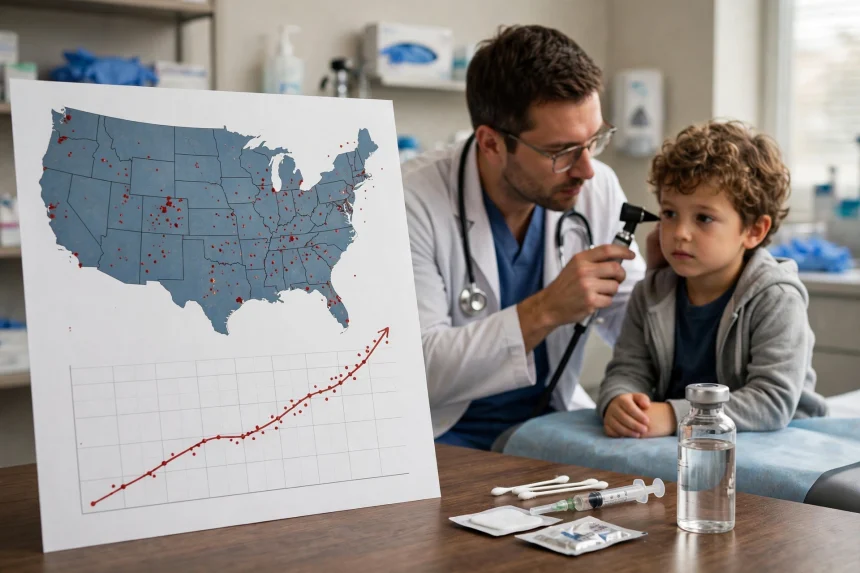
Measles is surging in the United States at a pace that has alarmed public health officials, with case counts climbing to levels not seen in years and outbreaks spreading across multiple states, according to data visualised in new reporting by the Associated Press.
Measles was declared eliminated in the US in 2000, meaning it no longer circulated continuously in the country. That status has not meant zero cases — infections imported by travellers have regularly sparked small outbreaks — but the scale and persistence of the current surge mark a clear break from the pattern of the past two decades.
What the numbers show
The graphics published with the Associated Press analysis chart a steep rise in confirmed cases, concentrated in communities where vaccination coverage has fallen below the level needed to stop transmission. Measles is one of the most contagious viruses known: it can linger in the air for up to two hours after an infected person leaves a room, and around nine in ten unvaccinated people exposed to it will become infected.
Health officials say the overwhelming majority of cases are among people who are unvaccinated or whose vaccination status is unknown, including many children. Hospitalisations have followed, and officials warn that severe complications — pneumonia, brain inflammation and, in rare cases, death — become more likely as total case numbers grow.
Coverage of major national developments on this site, such as our report on how Trump echoes Russia as he upends US position on Ukraine, shows how quickly fast-moving stories can dominate public attention; health officials are urging that the measles surge receive the same sustained focus before outbreaks grow harder to contain.
Why vaccination rates are central
Two doses of the measles, mumps and rubella (MMR) vaccine are about 97 percent effective at preventing measles, and communities typically need around 95 percent coverage to maintain herd immunity. National kindergarten vaccination rates in the US have slipped below that threshold in recent years, and they are far lower in some local pockets — exactly the places where outbreaks take hold.
Experts point to a combination of factors behind the decline: disruption to routine childhood care during the pandemic, misinformation about vaccines, and reduced trust in public health institutions. Whatever the cause in a given community, the result is the same — more susceptible children in the same classrooms, clinics and places of worship.
What happens next
Public health teams respond to outbreaks with case investigation, contact tracing, exclusion of unvaccinated students from affected schools and targeted vaccination clinics. Those measures work, but they are resource-intensive and become harder as cases multiply across jurisdictions.
Doctors are also urging parents to check their children’s records ahead of travel and the school term, and to watch for early symptoms: high fever, cough, runny nose and red, watery eyes, followed a few days later by the characteristic rash. Anyone suspecting measles is asked to call ahead before visiting a clinic or emergency room, so staff can prevent exposure to other patients.
The broader warning from the data is simple. Measles returns quickly wherever vaccination slips, and it finds unprotected people first — infants too young to be vaccinated, and people whose immune systems cannot fight the virus. Rebuilding coverage, officials say, is the only durable way to push case numbers back down and protect the elimination status the country held for a generation.
A preventable disease, a costly response
The human and financial costs underline why officials treat each outbreak seriously. A single measles case can require dozens of hours of public health work to trace contacts and verify immunity, while a large outbreak can cost a community millions of dollars in response efforts, medical care and lost work and school days. Those costs fall on top of the suffering of patients themselves, most of whom could have been protected by a vaccine that has been in routine use for more than half a century.
Clinicians stress that it is not too late to change course. Catch-up vaccination is safe and widely available, and even a modest rise in coverage in the most under-vaccinated communities would sharply reduce the virus’s ability to spread. As the AP graphics make clear, the trajectory of this surge is not fixed — it will be shaped by the vaccination decisions families and communities make in the weeks ahead.