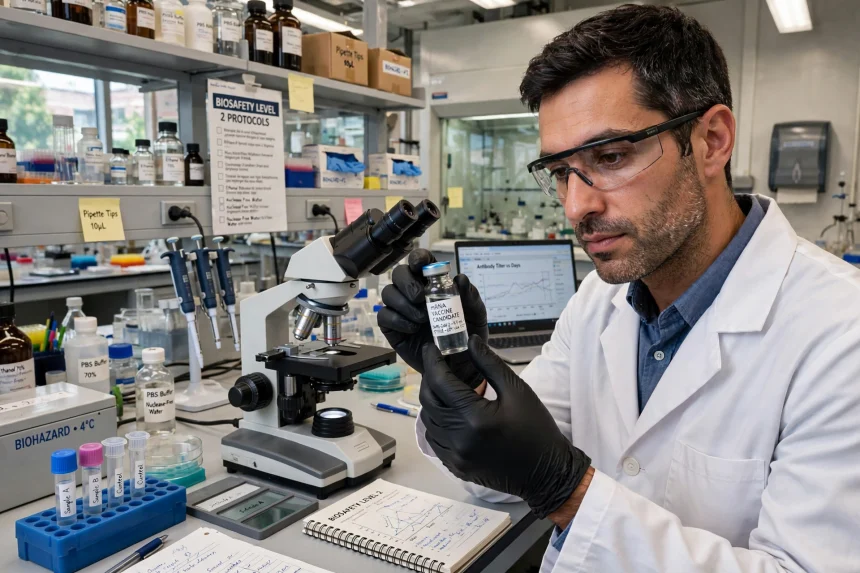
Precision is the whole story in the NeoVax trial. Researchers reported that a personalised neoantigen vaccine, made from each patient’s own tumour mutations and combined with nivolumab, could be manufactured and administered in a phase 1 study in platinum-sensitive recurrent ovarian cancer. They reported acceptable safety and observed immune responses. They did not report a cure, and they did not prove the vaccine improves outcomes. Any coverage that goes further than that is adding claims the study, published in Nature Medicine, does not carry.
The treatment, in plain words
A tumour’s mutations can create neoantigens, fragments that stand out from normal tissue. NeoVax selects such targets from an individual patient’s cancer and builds a vaccine intended to show them to the immune system. Nivolumab is a PD-1 checkpoint inhibitor; it works on a different part of the problem by releasing a brake on T cells. Reporting the combination accurately means naming both roles rather than treating NeoVax as a single magic ingredient.
For verified background, readers can use the National Cancer Institute and the journal Nature Medicine. Those sources also reinforce the setting: this was recurrent ovarian cancer with a specific platinum-sensitive profile, studied at an early stage, not a general announcement about all cancers or all patients.
Three reported findings, three limits
Feasibility came first. Personalised production is operationally difficult, so demonstrating that vaccines were actually made and given to the intended patients is a substantive result. Its limit is scale: a specialist trial workflow may not translate easily into routine, affordable care. Safety came second. Acceptable safety in a phase 1 group supports further research, but a small group cannot reveal every risk or represent people with different health profiles.
Immune response came third. T-cell responses indicate biological activity consistent with the vaccine’s purpose, which is encouraging for researchers deciding whether the concept deserves larger trials. The limit is the most important for readers: immune activity is a signal, not a clinical verdict. Whether patients benefit, and by how much, requires trials designed and sized to measure benefit.
Why framing matters in health media
Our newsroom’s health output ranges from data-led reporting on the measles surge in the United States, explained through case graphics, to emerging research like this. Established public health interventions and experimental personalised therapies sit at opposite ends of the evidence ladder, even when headlines give them similar energy. Keeping that distance visible is not caution for its own sake; it protects patients from mistaking a research milestone for a treatment option they can request today.
The accurate closing line
NeoVax with nivolumab has cleared the questions a phase 1 trial is meant to ask: can it be made and given, is safety acceptable enough to continue, and does the immune system respond? Larger studies must now ask whether it helps, for whom, and at what practical cost. That is a meaningful research advance and a clear agenda for follow-up reporting. It is not, yet, an efficacy story, and presenting it honestly makes the genuine progress easier, not harder, to recognise.
A short glossary for this story
Three terms carry most of the meaning here. A neoantigen is an abnormal protein fragment produced because a tumour has mutated; it can serve as a target because healthy tissue does not display it in the same way. A checkpoint inhibitor such as nivolumab blocks a control point, in this case PD-1, that can slow T cells down. And phase 1 describes the earliest stage of human testing, focused on safety and whether a plan can be carried out at all, rather than on proving benefit in a large population.
With those definitions in place, the study’s contribution becomes easier to place. It connects a molecular idea, a manufacturing process and an immunotherapy drug into one delivered intervention, then reports honestly on the first three measures available: it could be done, it was tolerated acceptably, and the immune system responded. Later phases exist precisely because those measures, however necessary, are not sufficient.